Demand Gen vs. Performance Max: Choosing the Right Campaign for Your Marketing Goals
Demand Gen vs. Performance Max: Choosing the Right Campaign for Your Marketing Goals
Author:
Mitchell Awisus
Insight
Two of the most popular campaign types on Google Ads right now are the Demand Gen and Performance Max campaigns (PMax). Both aim to help you reach your target audience at specific points along the conversion funnel. However, choosing the wrong campaign type can lead to unexpected, and potentially lackluster, results.
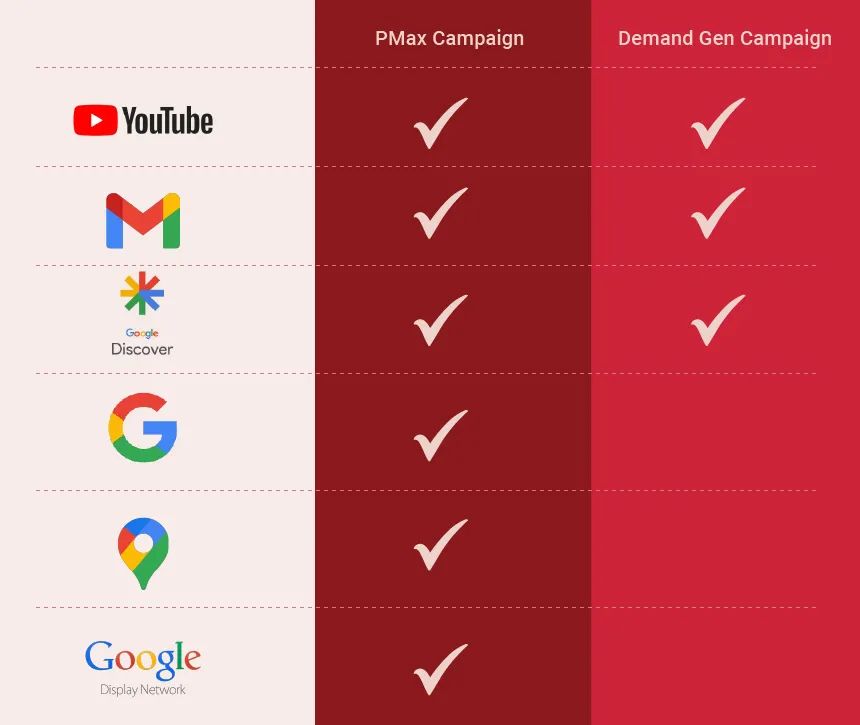
A Demand Gen campaign on Google Ads is an AI-driven campaign type that helps brands create new customer demand by delivering personalized image and video ads across YouTube, Discover, and Gmail.
A Performance Max (PMax) campaign is a goal-driven, AI-powered campaign type in Google Ads that automatically promotes your business across all Google channels—including Search, Display, YouTube, Discover, Gmail, and Maps—from a single campaign.
Demand Gen campaigns are best for building awareness and interest, while Performance Max campaigns focus on driving sales and conversions. Both can do a bit of each, but choosing the right type for your audience helps you get better results. Keep reading to learn how they differ in their goals, function, and creative requirements.
The changing landscape of Google Ads
In my role as a Digital Media Specialist, there is one thing that is always constant: change. This is truer now than ever, especially when it comes to the always-evolving landscape of Google Ads. Google is constantly updating its algorithms to help advertisers reach their customers. While this is helpful, the differences between campaign types can still be confusing for both new and experienced advertisers.
Demand Gen and Performance Max campaigns are two of the most popular campaign types in 2025, and for good reason. Both are great at getting high quality traffic to your landing page and finding users across Google’s large network of apps, tools, and websites.
So, when should you use a Demand Gen campaign? When should you use Performance Max? Can you use both at the same time? What are the targeting options, specs, and strategies for both? Is one inherently better than the other?
This blog will answer these questions and more—let’s dig in.
What is a Demand Gen campaign on Google Ads?
Most Google Ads campaigns target people actively searching for a product or service, whereas Demand Gen campaigns focus on introducing your brand and generating interest with new audiences. Google’s AI learning powers the Demand Gen campaign type by automatically optimizing your targeting and creative combinations to find people who are most likely to engage with and enjoy your ads.
This is why Demand Gen ads are so great for upper-funnel marketing. They capture interest and push users toward a specific goal, and at the same time create awareness and brand recall. The Demand Gen campaign type also gives you more control over reporting and analytics. As of November 2025, Performance Max campaigns have more limited reporting options.
What is Pmax?
A Performance Max (PMax) campaign combines your creative assets with Google’s machine learning to identify high performing audiences based on your specific goals and conversion points. In plain English: A PMax campaign takes your creative assets, puts them in front of a qualified audience, and pushes them toward your marketing goals.
PMax campaigns work well across the entire funnel, but they tend to excel at mid- to lower-funnel conversions. PMax uses Google’s full ad inventory, giving marketers exceptional reach and ad spend efficiency while helping reduce manual setup.
This is best for advertisers looking to reach their audience across multiple channels. The coolest part is that after the initial setup, Google does all the work for you through AI automation and audience data—all you have to do is take credit for the conversions your campaign generates.
When to use each and why
Both the Demand Gen campaign type and the PMax campaign type are powerful tools that you can use to reach your audience. So, when should you use one versus the other?
Demand Gen vs. Performance Max: Goals
You should use the Demand Gen campaign when your goals are to:
Reach a new audience that may not know your brand well
Build awareness and interest
Fill the top of your marketing funnel
If you are launching a new product or a brand storytelling campaign, or trying to expand into new markets, a Demand Gen campaign might be best for you.
You should use a PMax campaign when your goals are to:
Drive conversions, leads, or online sales
Maximize ROI across multiple Google channels
Automate your campaigns fully with AI
Reach people who already have an interest in your product or service
If you are in e-commerce sales, lead generation, or want to remarket to users, a PMax campaign might be best for you.
Demand Gen vs. Performance Max: Conversion Focus
One of the biggest differences between these campaign types is conversion limitations. Without a strong conversion point, a Demand Gen campaign won’t fully optimize, while a Performance Max campaign may stop running entirely.
Why does this happen? Let’s look at a real-world example. If you were driving to a friend’s house for the first time and they only told you what side of town they live on, it would be very difficult to find their exact address. You could drive in the right direction for a while, but you would eventually get confused and lost, with no idea where to turn next. If instead, your friend gave you the exact address, and location markers and offered to stand outside their house waving their arms, you would be able to find your destination more easily.
PMax and Demand Gen campaigns behave in the same way. The more information you give them, the easier it is to find the right audience and deliver them to the right destination.
Pro tip: PMax is much more strict on this conversion point than Demand Gen. If you do not have a strong conversion point, PMax is not the right campaign for you.
What assets do you need for a Demand Gen Google Ads campaign?
In addition to conversions, there are distinct differences between the assets you need for each campaign. If you do not have the right assets for your Demand Gen campaign, your campaign will not run at its best.
Up to 5 videos
Business name and logo
Up to 5 unique headlines, long headlines, and descriptions
Call to action
Up to 4 sitelinks
What assets do you need for a PMax campaign?
PMax campaigns are much stricter than Demand Gen, and most of the time, Google will not let you run the campaign without maxing out all available assets. Before running this campaign, make sure you can provide the following assets:
15 unique headlines, 5 unique long headlines, and 5 unique descriptions
20 images
5 videos
Call to action
Up to 6 sitelinks
Where are my ads actually shown?
Depending on the campaign type, your ads will show across a variety of Google platforms and partner websites.
PMax uses Google’s entire inventory to showcase your ads—which includes Search, Display, YouTube, Discover, Gmail, and Maps—to give your ads an “everywhere all at once” sense. Demand Gen ads have a more limited inventory, showing your ads across YouTube, Discover, and Gmail.
By turning on the Google Display network, your ads will also run across Google’s third-party sites and apps. Google will automatically adjust to fit publisher formats, giving you even more reach for your campaigns.
Strategy tips for each campaign
If you are looking to run a strong video campaign that targets upper-funnel awareness, the Demand Gen campaign type might work best for you. If you are looking for strong conversions/sales/leads, targeting users who are familiar with your brand and ready to take the next step, PMax might be the best for you.
If you have additional budget and want to target the full funnel, having both of these campaigns run side by side will do the trick. This will create upper-funnel awareness and bottom-of-funnel conversions, helping you find new customers and convert existing ones.
Beware though, if you are using the same assets and the same messaging for each campaign, they may work against one another. Create assets and copy that complement one another so that by the time a customer completes your funnel, they know who you are, what you are selling, and why your product is the best fit for them.
Now what?
The Demand Gen and PMax Google Ads campaigns are both very good at what they do. They find qualified traffic, tell users about your brand and/or product, and push them toward a conversion point of your choosing.
Once you have your Google Ads paid strategy down, how is your tracking and analytics setup looking? Check out our data tracking blog to learn how to track the conversion points that you care the most about. Remember, even the strongest creative needs a strong conversion point to succeed.
Download your free campaign tracking checklist
SHARE
Get Updates
Sign up to get the latest updates on the Estiponies, industry news and what not. We promise to be responsible with your information and not sell it off to the dark web.