Ironically, for a word that means understanding, empathy is quite often misunderstood. As a writer whose entire job revolves around it, I’m setting the record straight.
What empathy is, and what it is not
Merriam-Webster defines empathy as “the action of understanding, being aware of, being sensitive to, and vicariously experiencing the feelings, thoughts, and experience of another.” Empathy ends with understanding. It does not require agreement or approval.
For example, when Estipona Group was developing a Meth Prevention Campaign for LGBTQ+ resource center Our Center, it was critical to understand the experiences and perspectives of gay men who use meth as a party drug or coping mechanism. This doesn't mean every member of our team needed to agree with drug use or condone it, but we needed to understand it. We needed to understand what drives that harmful, often deadly, behavior. Empathy was the first step in understanding our target audience, so we could communicate in a way that would resonate. Once we had their ear and trust, we could share important health information.
Why is it important?
At its core, empathy is about building relationships. So is marketing.
People don’t trust a brand they feel disconnected from. They don’t act on a message that doesn’t resonate with them. Empathy works behind the scenes in every part of my creative process, from writing briefs to high-level concepting to writing the words that appear in an ad. It allows me to build relationships with various audiences by meeting them where they are—whether it’s someone who just lost their job or someone buying their first house. At Estipona Group, we work with clients across different industries, speaking to people whose lives look nothing like mine. Understanding them allows me to write what resonates, and that resonance is what inspires action.
Empathy also shapes relationships within my work. Understanding coworkers’ and clients’ perspectives helps me collaborate more effectively, navigate challenges thoughtfully, and communicate in a way that’s informed, clear, and productive—even in times of disagreement. Mutual understanding results in a stronger team that produces better work and has more fun while doing it.
Outside of the workplace, empathy enriches everyday relationships. It teaches patience, curiosity, and respect. It encourages me to pause before reacting and listen before judging. Whether in a professional setting or in everyday life, practicing empathy strengthens the bonds that make meaningful interaction possible.
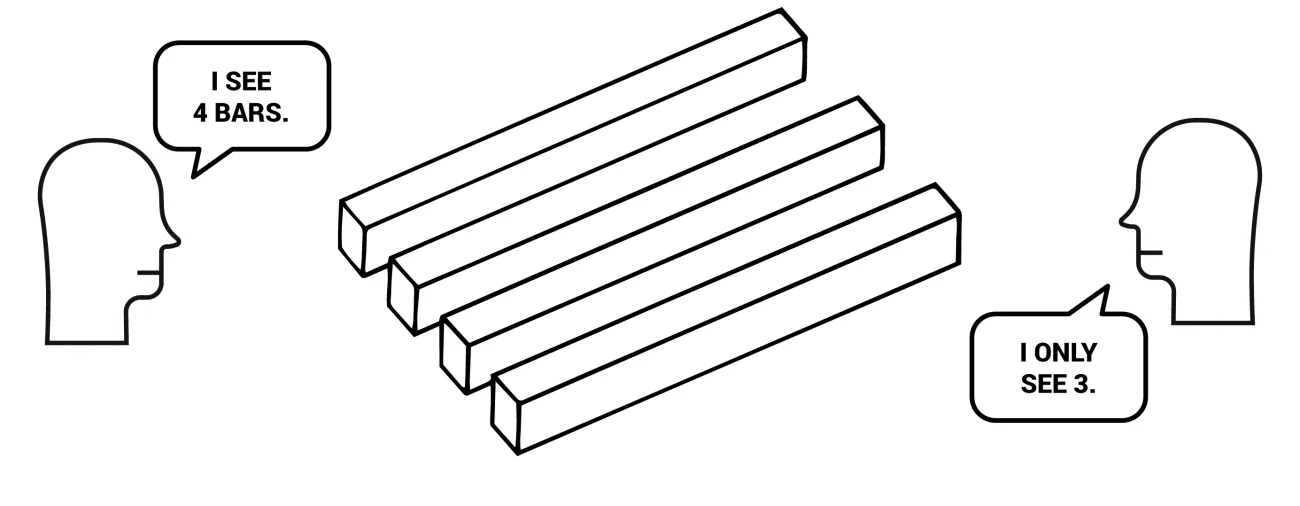
It's all about perspective.
How to practice empathy
Empathy is a soft skill that’s hard to master. It’s not something you can learn from a textbook or newsletter. It’s something you can only practice by immersing yourself in something foreign—a feeling or experience that isn’t your own. Empathy often asks you to reject your existing understanding of the world. It requires putting yourself in someone else’s shoes—shoes that are worn and don’t fit quite right. It can be awkward, uncomfortable, and confusing. But just like any muscle, it gets stronger with practice.
Be curious.
Foundational to empathy is asking questions rather than making assumptions. Questions lead to discussion, which leads to answers. Answers lead to understanding, and understanding someone—even if you don’t share their attitudes or experiences—is practicing empathy. In the context of marketing, this means asking questions about your audience and the experiences that have shaped their perspectives and behaviors.
For example, take the Youth Vaping Prevention Campaign Estipona Group developed for Northern Nevada Public Health. Science tells us that vaping isn't good for our health. It’s harmful physically, mentally, and financially—so why do teens do it? What is the appeal? Why don’t they seem to care about the implications? By asking questions, we learned that youth vape because it’s considered cool, it’s a coping mechanism, and many just don’t know any better. Putting ourselves in the sneakers of a teenager, rather than the oxfords of an authority figure, allowed us to educate, resonate, and inspire action.
Immerse yourself.
Another way that I empathize with a target audience is by putting myself in their world as much as possible. My TikTok algorithm is a permanently disfigured compilation of every audience I’ve built a relationship with through marketing—from blue-collar workers to women with breast cancer to train enthusiasts. It’s the result of countless hours of scrolling through the various worlds of each audience, learning about their experiences, wants, needs, and fears. And while I know how creepy that sounds, it’s about getting to know and appreciate my audience as intimately as I can. This informs how I communicate, whether it’s tone, specific word choice, or topics to hit or avoid.
Listen to understand, not to respond.
Most of us don’t like failing, being rejected, or looking stupid in front of other people. Instead, our brains naturally seek the “right” answer and crave the validation from others that comes with it. Empathy requires us to withhold this instinct—to set our own biases and right answers aside, to accept that someone else’s understanding of the world is different from our own. Through this, we learn and build trust. This leads to communication that is better informed and better received.
What I hope you take from this
1. Empathy takes work.
Empathy isn't automatic. It’s a skill you can strengthen through curiosity, mindfulness, and real effort. As with any skill-building, it might be uncomfortable. Embrace the discomfort because it probably means you’re doing something right.
2. Empathy is generally something we should strive for.
It’s easy to become absorbed in our own little bubbles and our own problems. But when we empathize with others, we gain a deeper understanding of the world in general. Empathy enables us to be more informed, more intuitive, and more capable of making an impact.
SHARE
Get Updates
Sign up to get the latest updates on the Estiponies, industry news and what not. We promise to be responsible with your information and not sell it off to the dark web.